Kanye West is making waves again. The cover of his upcoming album My Beautiful Twisted Dark Fantasy has his label pushing for a different cover since Wal-Mart has indicated they are unwilling to sell the sexually graphic current cover in their stores. The controversy prompted Billboard to feature "20 Banned Album Covers" this week. I was interested to see that in most cases the new cover was just a covering up of parts of the original. One famous example of that is the nude shot of John Lennon and Yoko Ono covered with brown paper. Viewing the slide show of the banned album covers made me think of book covers. It wasn’t much of a jump because several things had worked together to put book covers on
my mind.
my mind.


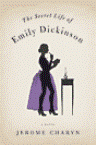
First, I recently looked at a couple of collections of book covers. Abe Books posted an exhibit of 25 Iconic Book Covers in their online Rare Book Room. Looking at those covers, I realized that about half of them were so distinctive and so familiar that I would have known the books even if the titles had been omitted from the covers. I have only to look at my own bookshelves to see some of these, such as The Catcher in the Rye and To Kill a Mockingbird. I also viewed another collection of covers. AIGA, the professional association for design, selected 100 examples of outstanding book and book cover design produced in 2009. Most of these books I’d never heard of, and only one, The Secret Life of Emily Dickinson by Jerome Charyn, had I read. Frankly, it was only one of a handful that I would have found interesting enough to stop and check the book in a bookstore or library.
 The third item that has me focused on book covers is that a few weeks ago I bought a supply of stretchy fabric book covers to hide the covers of my romance novels. I bought mine locally, but they are readily available. The one pictured is from Hide-a-Book on Etsy. I have never been a fan of clinch covers, but hiding the covers always seemed like surrendering to the critics of romance fiction. I had one cover I used for my purse book, whatever it happened to be at any given time, since I pulled it out everywhere from a jury room to a church committee meeting. But lately the questions about my romance covers from the Grands have persuaded me that the time has come to cover the covers.
When I first started reading my mother’s romance novels, the covers might have been dismissed by critics as silly and trite, but they didn’t need to be hidden from the eyes of children. I thought the covers were wonderfully romantic. Clinches, when they existed were strictly G rated. What I remember are the beautiful people and the glamorous settings. I was not a fan of the bodice rippers of the 1970s, although the covers of the two most influential, which I did read, were certainly inoffensive. The books I was reading during that period were Gothic romances, Clare Darcy’s Regencies, and categories by writers such as Essie Summers, Mary Burchell, and Sara Seale. The covers of the subgenres were distinctive from one another, but none of them would have embarrassed their readers.


When I think of what some have called the Golden Age of romance fiction, the 1980s, I think of the writers I was discovering during that time, writers like Mary Balogh, Jo Beverley, Mary Jo Putney, Nora Roberts, and Kathleen Gilles Seidel. Most of their books from that time are still on my keeper shelves, and while some may be labeled “clinch covers,” none makes me want to hide it from view. Even the cover of Seidel’s All Through the Years, the sexiest of the covers in this sample, seems mild to eyes accustomed to 21st-century covers.


Was it in the 90s that the shift began? I’m not sure. This is a rambling recollection of my experience with romance covers, not an academic study. I do know that it’s easy to see the forerunners of today’s sizzling covers in Loretta Chase’s acclaimed Lord of Scoundrels and in Lisa Kleypas’s popular Then Came You. On the other hand, some books that definitely merited the “Hot” warning such as Christina Dodd’s A Well-Pleasured Lady and Judith Ivory’s Sleeping Beauty have quite subtle covers, the kind I can still leave on a table or chair, careless of who may see them.


That pattern can be seen in recent covers as well. Two of the books that prompted the Grands’s questions were Julie Anne Long’s I Kissed an Earl and Anne Mallory’s Seven Secrets of Seduction. Yet Toni Blake’s Sugar Creek, which has a higher sensuality level than the Long and the Mallory books, has a cover that I feel no need to hide.


Please don’t misunderstand me. I am not advocating banning covers. Since they are so ubiquitous, I will concede that many readers must like the clinch covers and the experts insist they sell. Borders romance buyer Sue Grimshaw was quoted in a 2008 Publishers Weekly article saying, “A tastefully done clinch is a must-have for debut authors.” And in that same article, Carrie Ferron declared, “We're pro-clinch at Avon.” So I’m in a minority here not banning, just covering romance covers—some of them—and thinking nostalgically of the day when I could just leave my romances uncovered for all eyes to see and dream of a day when the covers of romance novel will be both distinctive and appealing to readers.
How do you vote on clinch covers—yea or nay? Have you ever used book covers on romance novels? What kind of covers do you prefer on the books you read?