Showing posts with label favorites. Show all posts

Friday, February 1, 2013

Series Addiction

From The Wandering Reader
Sometimes subjects just seem to be in season. Everywhere you turn, unrelated groups are talking about the same topic. Such was the case in January 2013 with the subject of related books. Counting online and real life conversations, I’ve been engaged in seven different discussions about books in series during the past thirty-one days. In most of these conversations I have labeled myself a “series addict,” thinking I was exaggerating for a touch of humor. But my most recent discussion with an old friend about the series we read as children made me realize that perhaps “addiction” is the most accurate word to describe our almost life-long love of series. The OED defines “addiction” as “The state or condition of being dedicated or devoted to a thing, esp. an activity or occupation; adherence or attachment, esp. of an immoderate or compulsive kind.”  I think “devoted” is certainly describes annual readings of book over a period of many years, and I’m persuaded many people would see such activity as “immoderate.”

 
The books she and I read and reread and talked about endlessly as girls had been published years before we read them; three of the series our mothers had read as children. We loved the fact that the stories didn’t end after one book. We eagerly followed the adventures of Louisa May Alcott’s March sisters (three books, published 1868-1886), Margaret Sidney’s Five Little Peppers (twelve books, published 1881-1916), Lucy Maud Montgomery’s Anne Shirley (eight books, published 1908-1939), Laura Ingalls Wilder’s Ingalls family (eight books, published 1932-1943), and Maud Hart Lovelace’s Betsy Ray, Tacy Kelly, and Tib Muller (ten books, published 1940-1955), sharing their lives from their childhoods to their adult lives when they married and had children of their own.

We both have copies of these series on our keeper shelves today and even some of them occasionally, and we both smile when we are reminded that at least with Alcott, Montgomery, Lovelace, and Ingalls, girls in the 21st century are still reading and loving their books. You can bet we took note last year when NPR published their audience-chosen list of the best YA books of all time, two of our favorite series were on the list: the Anne of Green Gables books at #14 and the Betsy-Tacy books at #100. The Sidney books, perhaps the most Victorian in tone, don’t seem to have survived as well as the others.


The pattern of addiction established when we first began to read has endured for more than half a century. We rarely read the same books these days. Her first choice for leisure reading is mysteries or thrillers with a few romantic suspense series thrown in, and mine is romance, heavy on the historical and contemporary. But our bookshelves are still filled with series, we still reread our favorites, and we still talk about what we are reading. We agreed to research our shelves to see how great a hold our addiction has on our time, our purses, and our space. She has just over a hundred series on her keeper shelves. I have 188 current romance series keepers, including digital and print books, but I did some major purging of books when I moved to a smaller house four years ago. According to my book catalog, at one time I had more than 400 series represented on my bookshelves. 


Grace Burrowes, whose Windham series is among my keepers, was a guest of the Romance Bandits earlier this week. She responded to a comment I made about my favorite series by saying she hoped my keeper shelves were insured since I had a history of historical romance on them. The comment sent me back to check my shelves, and it’s almost true. I have series that range from Georgette Heyer’s Duke of Avon’s family series (three books, 1921-1937) to Manda Collins Ugly Duckling trilogy (three books, 2012-2013). Mary Balogh is the series queen though. I have thirteen series by her. 

The most read series is Jo Beverley’s Company of Rogues (fourteen books and a novella, published 1991-2007). I read An Arranged Marriage (Book #1) when it was released, and as each book in the series was released, I reread all those that preceded it, and then in 2009, I reread the whole series. I’ve read Mary Jo Putney’s Fallen Angels (seven books, published 1993-1997) and Loretta Chase’s Scoundrels (four books and a novella, published 1992-1998) almost as often. Other favorites for rereading include Balogh’s Dark angel sequence (seven books, 1994-1997), Jo Beverley’s Mallorens (twelve books,1993-2012—with #13 due this year), Loretta Chase’s Carsingtons (five books, 2004-2010), Anne Gracie’s Merridew Sisters (four books, 2005-2007), Eloisa James’s Essex Sisters (four books, 2005-2006), Carla Kelly’s Libby’s London Merchant (1991) and One Good Turn (2001), Lisa Kleypas’s Then Came You (1993) and Dreaming of You (1994), and Julia Quinn’s Bridgertons (eight books, 200-2006)—my current reread since reading the second epilogue collection, Happily Ever After (April 2, 2013).


My contemporary keeper collection may be historically less impressive, but it is no less cherished. Nora Roberts is the undisputed queen here. At one time, I had twenty-seven of her series. I now have only seventeen, but her MacGregors (ten books and a novella, 1985-1999), O’Hurleys (four books, 1998-1990), Stanislaskis (six books, 1990-2001), Concannons (three books, 1994-1995), MacKades (four books, 1995-1996), Quinns (four books 1997-2002), and Gallaghers (three books, 1999-2000) are comfort reads that I have read again and again and again and . . . 

Robyn Carr’s Virgin River series (eighteen books and three novellas, 2007-2012) may be the longest series in my collection, but I’ve read her Grace Valley books (three books, 2000-2003) more often. Other series that I often pull out for a reread are Jean Brashear’s Deep in the Heart (four books, 2003-2004), Kathleen Korbel’s (aka Eileen Dryer) Kendalls (five books, 1987-2006), Lisa Kleypas’s Travis family (three books, 2007-2009—and, oh, how I long for a fourth!), Curtiss Ann Matlock’s Valentine books (seven books, 1999-2009), Marilyn Pappano’s Bethlehem series (nine books, 1997-2003), and Susan Elizabeth Phillips’s Chicago Stars (seven books, 1994-2007). Meg Benjamin’s Konigsberg books, Julie James’s FBI/US Attorney books, and Shannon Stacey’s Kowalskis are ongoing series that I love and expect to become favorite rereads.


And I haven’t even touched upon the mystery series—not to mention the Harry Potter books, which I’ve read in full three times, some books more often. Did I say my name is Janga and I’m a series addict?


Do you have a series addiction? Are you a rereader? If you could take only three series to a desert island with you, what would you take?


Friday, March 2, 2012

Considering Rakes

Johnny Depp as Rochester

This week I’ve been thinking about rakes. First, I’ve recently read a soon-to-be-released book that features one of the best rakish heroes ever. Second, the responses to a question Sarah MacLean posed about rogues at The Romance Dish made me question if “rogue” and “rake” are synonymous. I don’t think so. “Rogue” connotes a lack of honesty and scruples that is not necessarily characteristic of a rake. Some heroes may be both rakes and rogues, but some are one or the other.

In his 1755 dictionary, Samuel Johnson defined a rake as “a man addicted to pleasure.” Historically, the term may be most famous as a description of the “Merry Gang,” as the poet Andrew Marvell called the group of English wits who were part of Charles II’s circle. Known for their debauchery, heavy drinking, and love affairs, these men expressed their ideas—some scandalous and some substantive—through limericks, lampoons, and satirical plays. The most famous of the group was the fascinating John Wilmot, second Earl of Rochester (1647-80).  Rochester’s contemporary friend, the playwright Sir George Etherege is said to have based the rake Dorimant, a character in his play Man of the Mode, on Rochester. The play was first performed on March 2, 1676.  

While rakish heroes in romance novels are not guilty of Rochester’s most outrageous offenses, Etherege’s description ("I know he is a Devil, but he has something of the Angel yet defac'd in him.") is one that might be used to describe many of romance fiction’s most beloved rakes. Just think how many of them are referred to as “fallen angels” or bear nicknames such as “Devil” or “Lucifer.” Opinion is divided concerning Rochester’s deathbed religious conversion, but romance readers are unanimous in their expectation that a rake will be transformed by the power of his love for one woman.

After much consideration and even some rereading, I have narrowed a list of approximately fifty rakish heroes I love to a dozen (alphabetized by author), and I’m adding the new one I mentioned to make it a baker’s dozen.

Stepback for A Duke of Her Own by Eloisa James,
a novel that features another of my favorite rakes,
Leopold Dautry, Duke of Villiers/
1.     Piers Verderan, Emily and the Dark Angel (1991), Jo Beverley
A true rake, Piers, known as the “Dark Angel” is aristocratic, witty, and experienced, although he is less dark than his reputation paints him, an attribute he shares with many a rake in romance.

2.     Lucien, Marquess of Arden, An Unwilling Bride (1992), Jo Beverley
Lucien is rake lite. His hard-drinking, hedonistic lifestyle seems more youthful rebellion and lack of purpose than entrenched character. Even before he falls in love with Beth, he moderates his habits.

3.     Tarquin Vale, Earl of Ashcroft, My Reckless Surrender (2010), Anna Campbell
Tarquin is a rake ripe for reform. He has the reputation of being a man who can’t say no to the women, from aristocrats to courtesans, who are eager to share his bed, but he is already sated with his self-indulgent life. His reformist politics and love of antiquities also suggest that he is more complex than his reputation suggests.


      4. Vere Mallory, Duke of Ainswood, The Last Hellion (1998), Loretta Chase
Vere behaves as a rake to escape the pain of all the losses in his life. The fact that he, the younger son of a younger son, inherits the title speaks to how great the losses are. From his first encounter with Lydia Grenville, his days as a rake are numbered.


Stepback for Nine Rules to break When Romancing a Rake
by Sarah MacLean, a book that features yet another favorite
rake, Gabriel St. John, the Marquess of Ralston.
  5. Sebastian, Marquess of Dain, Lord of Scoundrels (1995), Loretta Chase
Dain is the quintessential rake in character if not in looks, debauched and dissolute and influencing others to follow in his path. But no redemption of a rake has ever been more delicious than Dain’s.

  6.     “Saint,” the Marquis of St. Aubyn, London's Perfect Scoundrel (2003), Suzanne Enoch
The very worst of rakes at the beginning, ruthless, self-centered, interested only in bedding the heroine, his transformation is incremental and credible. He truly is a changed man by the book’s end.

  7.     Gideon, Lord Carradice, The Perfect Rake (2005), Anne Gracie
He really is the perfect rake. A womanizer and a charmer who turns a compliment with practiced grace, he is at first amused and then totally blindsided by love for Prudence Merridew, the plain sister among a bevy of beauties.

      8.  Lord Jasper Damerel, Venetia (1958), Georgette Heyer
Damerel is a prototype of the Regency Rake. His “careless elegance,” “cynically bored” eyes, “swashbuckling arrogance,” and the “laughing devil in his sneer” are adapted and reused for generations of     rakes.


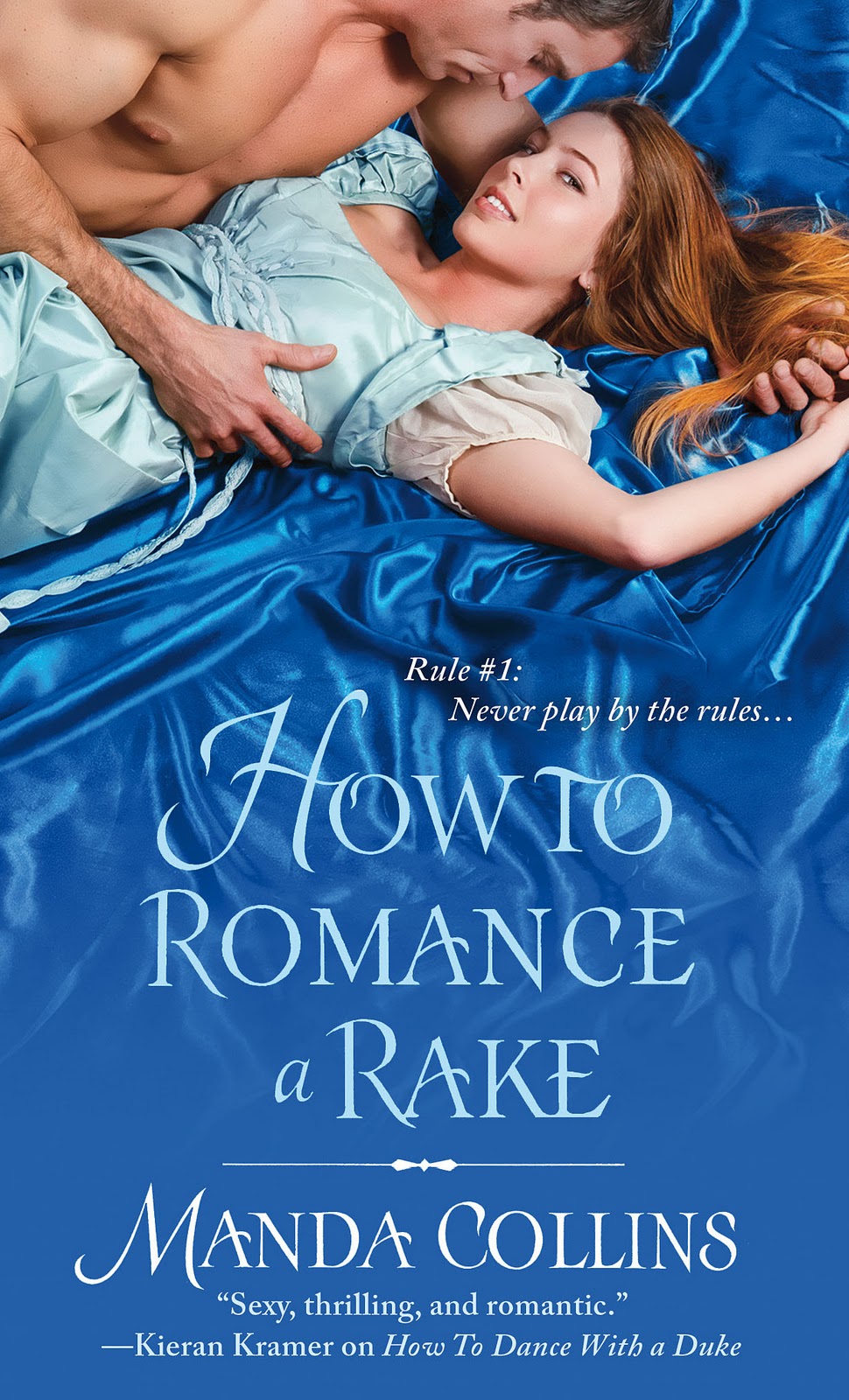
How to Romance a Rake (July 31, 2012)
by Manda Collins  features a hero whom
I expect to add to my list of favorite
rakes, Lord Alec Deveril.
9.     Garrett Langham, Earl of Mayne, Pleasure for Pleasure (2006), Eloisa James
Mayne’s character arc covers five books, and by PFP, he really is a former rake. But in the beginning, London is filled with his former inamoratas, and Mayne is selected as the perfect lover for Helene, Countess Godwin, in Your Wicked Ways. Suffering from ennui when he encounters Helene, his transformation begins then and is completed with the HEA in Pleasure for Pleasure.

10.     Derek Craven, Dreaming of You (1994), Lisa Kleypas
Derek Craven is no aristocrat. A nameless waif who became a chimney sweep, a thief, a grave-robber, and a gigolo before he became a gambling club owner and one of London’s wealthiest citizens, Craven has had scores of lovers, none of whom has touched his heart. He is both rake and rogue until Sara Fielding teaches him that he is capable of loving and worthy of being loved.

    11.     Reginald Davenport, The Rake (1998), Mary Jo Putney
A wastrel and a drunkard, Reggie is on the road to self-destruction when an act of generosity and compassion gives him a chance to reclaim his life. Meeting Alys Weston gives him courage to fight his         demons, a friend and champion, and eventually an HEA.


      12.  Michael Stirling, When He Was Wicked (2004), Julia Quinn
Michael Stirling is known as the “Merry Rake” because of his indulgences, but one look at Francesca Bridgerton is all he needs to know he’s found his love. The problem is his cousin and best friend, John Stirling, Earl of Kilmartin, and Francesca are about to be married. Michael accepts the role of friend until John’s death gives Michael a title he never wanted and guilt that sends him running from Francesca for four years.


13. Colin Sandhurst, Lord Payne, A Week to Be Wicked, Tessa Dare
I’ll be reviewing AWTBW soon. For now, I’ll just say that Colin is one rake who made me cry, made me laugh, and totally captured my heart. Don’t miss this one.


Who are your favorite rakes?


WINNER: Kati, you are the Randomizer's choice to win the books from last week's giveaway. Please contact me at jangarho at gmail dot com.


Thursday, October 15, 2009

Anthology Appreciation Week


I’m writing this on Monday, not my favorite day of the week. I always think there should be a day between the end of the weekend and the start of the new week, a low-key day that makes little demands. Maybe then I would like Mondays better. It’s also raining today, and the song running through my head is an old one—“Rainy Days and Mondays” by the Carpenters.

Talkin' to myself and feelin' old,
Sometimes I'd like to quit.
Nothing ever seems to fit,
Hangin' around,
Nothing to do but frown.
Rainy days and Mondays always get me down.

One thing that can raise my spirit on a Monday and a rainy day is a good book. Today I’m rereading the repackaged edition of Scottish Brides, a 1999 anthology featuring novellas by Christina Dodd, Stephanie Laurens, Karen Ranney, and Julia Quinn. My rereading has reminded me of how much I love anthologies. I hate piecemeal reading, but usually I’m forced into it. I don’t often have the luxury of the free hours it would take to read a book at one sitting. But I can read a novella in an hour or less and enjoy that satisfying feeling of having finished a good read. An added benefit is the occasional delight of discovering a new-to-me author whose voice I love.

Scottish Brides is such a delight that it set me to thinking about my favorite anthologies. Could I choose seven favorites, one for each day of a private observance of Anthology Appreciation Week? After checking my catalog of keepers, I decided that I could do so only if I imposed some limits.

No Christmas anthologies allowed on the list. I have so many Christmas favorites that they belong in a separate category.

No single-author anthologies allowed. Their keeper status was determined by a different criterion than multiple-author collections. This decision eliminates Here’s to the Ladies, a Carla Kelly collection of American frontier army stories that is a jewel.

No anthologies that are on the keeper shelf on the basis of a single story. These may merit the designation “favorite novella,” but they do not qualify as a favorite anthology. I strike Talk of the Ton and The One That Got Away with beloved stories by Eloisa James, Secrets of a Perfect Night with Rachel Gibson’s “Now and Forever,” which may be my favorite contemporary novella ever, and In Praise of Younger Men with Jo Beverley’s dark and steamy “The Demon’s Mistress.”

No short story collections permitted, only novellas. Now I cut collections by Eudora Welty, Flannery O’Connor, Alice Munro, Bobbie Ann Mason, and the Mossy Creek stories.

I’m left with a more manageable list that, with difficulty, I cut to my top seven anthologies plus one honorable mention. These are the anthologies I reread most often, the ones that mix authors I love with new discoveries, the ones that include multiple novellas that entertain, delight, and move me. These are the anthologies that I find most deserving of celebration during this self-proclaimed Anthology Appreciation Week.


1. Irresistible Forces
Irresistible Forces is an anthology of SF/Fantasy romances that I bought solely for the stories by Putney and Beverley, both long-time autobuy authors for me. It is my #1 favorite anthology because I enjoyed every story in it, and it made me a fan of such blended genre tales. I expected to love the stories by Beverley and Putney, and I did. MJP’s contribution, “The Alchemical Marriage,” is an Elizabethan-set story with a Spanish Armada connection. It also serves as a sort of prequel for her Guardian books. Jo Bev’s “The Trouble with Heroes” is a layered piece filled with humor, pathos, philosophy, and politics. The themes of sacrifice and honor will be familiar ones to readers of her romance novels. My only quibble is that I wanted it to be longer.

I had heard friends rave about Bujold’s Vorkosigan tales, but since I almost never read science fiction, I doubt that I would ever have read them had I not read “Winterfair Gifts” and realized that Bujold was writing about relationships. And Catherine Asaro’s “Stained Glass Heart,” one of my favorite novellas ever, includes such beloved romance tropes as arranged marriage and lovers who were childhood friends. It has an innocence and joy that fills me with delight just remembering it. Deb Stover’s “Skin Deep” is an angel story that is great fun to read and left me thinking someone should turn it into a movie; Jennifer Roberson’s “Shadows in the Wood,” the shortest in the anthology, is a Robin Hood tale in which Merlin and Arthur’s sword Excalibur figure.


2. The Further Observations of Lady Whistledown
Like most Julia Quinn fans, I love Lady Whistledown, and I think the LW anthologies were a brilliant idea. This collection is my favorite. I love following the thread that links the stories. Suzanne Enoch’s “One True Love” is a lovely arranged marriage tale with lively exchanges between an H/H at odds and great sexual tension. Karen Hawkins’s contribution, “Two Hearts,” is a friends-to-lovers romance that tickles the funny bone and warms the heart. Hawkins’s gift for creating strong, endearing characters holds true here. Royce and Liza are my favorites in the anthology. Mia Ryan’s “A Dozen Kisses” features a wonderfully interesting hero, one with a brain injury that makes him appear slow-witted. I enjoyed the story, but I was frustrated because I felt it deserved to be more fully developed than the format allowed. “Thirty-six Valentines” is a typical Julia Quinn offering. The characters delight, the dialogue sparkles, the conflict amuses, and the story is an A all the way.

3. Where's My Hero?
Please don’t throw things at me if I admit I’ve only read two of the three stories in this anthology. I have the greatest admiration for Kinley McGregor/Sherrilyn Kenyon’s achievements. I have friends who are huge fans of her work, but it’s just not for me. This anthology ranks high on my list because I adored the other two stories by authors I consider brilliant in knowing what they do best and doing it better than anyone else.

I’m one of those readers who has a long list of secondary characters whose stories I long for. This anthology is perfect for readers like me in this respect. The heroine of Lisa Kleypas’s “Against the Odds” is the mathematician daughter of Sara and Derek Craven (Dreaming of You); the hero is Jake Linley, the interesting doctor who appears in four Kleypas novels (Someone to Watch Over Me, Where Dreams Begin, Lady Sophia’s Lover, and Worth Any Price). About time he got his own story. I enjoy watching the relationship between these atypical characters develop, but the parts of the story I like best are the scenes where Sara and Derek, one of the best H/H pairings ever, appear.

I read Splendid when it was first published and have been a Julia Quinn fan ever since. I was delighted to learn that “A Tale of Two Sisters” was the story of Ned Blyden, a secondary character in Quinn’s first three novels. I loved the character, and his story is a perfect fit for him. He and Charlotte are wonderful together, and Ned’s “poetic” composition makes me literally howl with laughter. “Charming” is a word that’s overused, but it is the best description I know for this story that truly is “highly pleasing, delightful to the mind and senses.”

4. Faery Magic
In this anthology, four writers, including three of my long-time autobuy authors, combine the magic of myth and legend with the enchantment of Georgian and Regency settings to tell stories of the intersection of the human world and the world of faery. The stories are connected by the world they share, but each offers unique delights. Jo Beverley’s “The Lord of Elphindale” is about a half-faery, half-human heroine who defies the very purpose for which she was created in an act of love. Karen Harbaugh’s “The Faery Braid,” a new take on the old tale Rapunzel, shows the hard choices life requires. “The Love Talker,” Barbara Samuel’s tale of a faery lord, cursed for his heartless seductions, who learns love and compassion from a simple country maid, is a lovely story made even more extraordinary by Samuel’s gorgeous prose. The heroine of Mary Jo Putney’s “Dangerous Gifts” learns that coveted gifts may come with too high a price.


5. Scottish Brides
The novellas in this anthology are all rooted in Scottish history and folklore, but they may be most notable for exemplifying so well the qualities readers look for in each of these authors. Christina Dodd’s “Under the Kilt” is a sexy tale featuring Hadden Fairchild, the brother of the heroine in A Well Pleasured Lady, a stubborn alpha who is all a Scots hero should be. “Rose in Bloom” by Stephanie Laurens is the tale of a rake reunited with the verbal sparring partner of his childhood, the Rose of the title. Julia Quinn’s “Gretna Green” has all the charm and fun I expect from a Quinn story and two likeable characters who share terrific chemistry and engaging banter. “The Glenlyon Bride” by Karen Ranney uses standard plots (arranged marriage and mistaken identity) to tell a sweet love story that is anything but standard in its development of a relationship that encompasses body, mind, and spirit.

6. Bride by Arrangement
I love Mary Jo Putney’s marriage of convenience tale, “Wedding of the Century,” in which an American heiress and a duke in need of a fortune discover how perfect they are for one another. Merline Lovelace’s “Mismatched Hearts” is a competent story of an H/H, engaged to the wrong people, whose honor is tested before their HEA is assured. “My Darling Echo” by Gayle Wilson is an unexpected treasure, the heart-warming tale of a blind earl and a struggling widow who marry first and fall in love afterwards.

7. Three Weddings and a Kiss
“The Kiss,” more short story than novella, is notable because it is the work of Kathleen Woodiwiss and features as hero Jeff Birmingham, brother of Brandon, the hero of Woodiwiss’s famous The Flame and the Flower. “Fancy Free” by Catherine Anderson is an American frontier tale of revenge and misunderstandings with some nice touches of humor, although I found it much less satisfying than Anderson’s best work like Annie’s Song and Phantom Waltz. Loretta Chase’s “The Mad Earl’s Bride” is among my top five novellas. There is nothing ordinary about this tale of a dying earl and the bluestocking heroine whose knowledge and stubbornness create a happy ending against all odds. The novella connects to Lord of Scoundrels, and Gwendolyn deserves a place beside Jessica Trent in the pantheon of romance heroines. “Promises” by Lisa Kleypas features a hero who is a shadow of Derek Craven and a heroine who persists in an inexplicable attachment to another man. Still, it’s Kleypas, and even a less than stellar Kleypas has much to recommend it.

Honorable Mention: It Happened One Night
All four novellas in this anthology tell the story of a man and a woman who meet serendipitously at an inn after years apart. Stephanie Laurens’s “The Fall of Rogue Gerrard,” which won a Rita for best novella, is vintage Laurens. A reformed rake meets a sensible woman from his past, is caught up in her most insensible scheme, and loses his heart. “Spellbound,” a tale of an estranged husband and wife who uncover the lies that separated them and rediscover their love, has the well-developed relationship, the emotional punch, and the memorable characters that have made Mary Balogh a legend in romance fiction. Jacquie D'Allesandro's “Only You,” a Rita finalist, is an interesting take on youthful lovers separated by class who are given a second chance. “From This Moment On” by Candice Hern ends her Merry Widows series. It’s my favorite among these stories. I love Wilhelmina, former courtesan and current widowed duchess. I love that she and Sam are mature characters. And I love that he was her first love. This one is a winner from an author who is underappreciated.

Do you appreciate anthologies? What are your favorites?