Thursday, November 25, 2010

Happy Thanksgiving!


May you have a
blessed Thanksgiving Day
filled with
good food, good memories, and
good times with people you love.

Thursday, November 18, 2010

Best “Other Books” of 2010

It’s that time of year when blogs and boards and publications begin to post their top books of 2010.  For the past several years, I’ve posted my top ten romance novels, and I’ll do so again soon. But I haven’t yet narrowed my list to ten. However, I do have a list of ten books in other genres that I have read and loved this year. Most of them are 2010 publications. A few were published in 2009, but I read them in 2010. So, in alphabetical order by author, here are my top ten “other books” of the year.

1. The Sweetness at the Bottom of the Pie by Alan Bradley
(Mystery, Delacorte, April 2009)
I came late to the reading of this book. Although I read a lot of mysteries, an eleven-year-old protagonist repeatedly described by those who had read the book as “precocious” didn’t sound like my kind of book at all. I was wrong. I loved Flavia, who is indeed precocious, but also funny, brave, and completely engaging. She has an interesting mind and, despite her toughness, a real vulnerability. How realistic is it that a pre-teen in 1950s England would have her own poison laboratory, be smart enough to outmaneuver her older sisters and a company of adults, and solve the mystery with skills that have more in common with Miss Marple than with Nancy Drew? Not very. But Bradley makes me believe for the duration of the book and leaves me eager for more adventures of Flavia de Luce. Book 2, The Weed That Strings the Hangman’s Bag, is on my TBR shelf now.


2. The Goddess of Fried Okra by Jean Brashear

(Women’s Fiction, Belle Bridge, March 2010)

I reviewed TGOFO here in early April. You can check the link for a full review. For this blog, I’ll limit myself to praising the book’s protagonist, Eudora "Pea" O'Brien, who moved me to laughter, tears and left me with the feeling that I’d found a friend. Her journey is one of the most original and satisfying female quest tales that I’ve read. When you add these qualities to a sterling cast of secondary characters, endearing eccentrics, who are interesting and memorable and a sense of place as rich as the best of Southern fiction, you’ll see why this book is on my list of the best.


3. The Wind Blows Through the Doors of My Heart by Deborah Digges
(Poetry, Knopf, May 2010)

This posthumously published collection, the fourth by Digges, sounds in the ear with a storyteller’s rhythm and resounds in the heart with a sparseness as deep as grief and a simplicity as powerful as love. The title poem introduces the volume, and it is not only thematic but also the best poem in a strong collection. Reading the poems, I was reminded of Sylvia Plath and Anne Sexton, but the tenderness and terror are uniquely Digges’s. Read the opening lines, read them aloud so that eyes and ears and being experience them. Then I think you’ll understand why I love this book.

The wind blows
through the doors of my heart.
It scatters my sheet music
that climbs like waves from the piano, free of the keys.
Now the notes stripped, black butterflies,
flattened against the screens.
The wind through my heart
blows all my candles out.


4. If I Stay by Gayle Forman

(Young Adult, Dutton Juvenile, April 2009)

I’ve read YA books since I was a pre-teen, and I continue to find some of the best and bravest books I read in this genre. Forman’s If I Stay reminded me a bit of Alice Sebold’s The Lovely Bones. One moment Mia is a seventeen-year-old cellist who expects to attend Julliard. She has a mother, a father, and a younger brother and a boyfriend who plays in a band. The next moment there are two Mias: one near death, a victim of an automobile accident in which her parents were killed and the other the consciousness of Mia who sees her own mangled body and later doctors working to save her. This second Mia watches as family and friends visit her, and she is confronted with a decision. Her life has been devastated by the accident. It will never be what it was before. Is such a life worth fighting for? Should she go or should she stay? This is not a comfortable book. (Many of the best YA novels are not comfortable reading.) It is heartbreaking, but it is also powerful and important

5. The Gentleman Poet by Kathryn Johnson

(Historical Fiction, Avon, September 2010)

This is another book I reviewed, this time quite recently for The Romance Dish. It is a blend of history, adventure, mystery, and romance—and Will Shakespeare himself is a character, writing The Tempest on the island that inspired it. I loved all the parts of this book: the 1660s setting, the real history with its politics and religious conflicts, the Renaissance Survivors (much better than any 21st-century reality show) the love story between the protagonist Elizabeth and the ship’s cook, and the friendship that grows between Elizabeth and Will.

6. A Bad Day for Sorry by Sophie Littlefield

(Mystery, Minotaur, August 2009)

Any list of favorite books that I construct probably signals clearly that the books I love best are character-driven. This debut novel introduced me to a character I adore and look forward to reading more of. We would never encounter Stella Hardesty in a romance novel. She is plump, plain, and past the 40s hill. After thirty years as an abused wife, she administered justice to her abuser with a wrench. No one is more surprised than Stella when she becomes the champion of other abused women, using her own brand of persuasion to convince the abusers to see the error of their ways. The issues at the heart of this mystery—domestic abuse, child endangerment, societal views of justice, acceptable heroines—are all serious concerns, but the serious is balanced by the comedic. I’ll just say I doubt that anyone has ever used erotic bondage equipment as Stella does. And she even gets a love interest. Littlefield has already published another Stella book with two more set for the future. I plan to read them all.

7. The Secret of Everything by Barbara O’Neal

(Women’s Fiction, Bantam, December 2009)

Barbara O’Neal (Barbara Samuel/Ruth Wind) is a writer who leaves me raving about the emotional punch of whatever she writes. The Secret of Everything joins a long list of favorites by this writer. Tessa Harlow, a travel guide, is left injured in body and spirit by a tragic accident. Against her father’s advice, still recovering from her injuries, she sets out for Los Ladronas, New Mexico, to check it out as a tour site and to uncover secrets of her own past. She meets Vince Grasso, a search and rescue worker who is widowed with three young daughters. Tessa and Vince strike sparks, but she is wary of commitment. The problem with a summary is that it makes the novel sound pedestrian when it is anything but. The summary gives no hint of O’Neal’s evocation of New Mexico in descriptions so powerful that the reader feels as if she’s been there and can’t wait to return. It leaves out the details that leave the reader hungry for food from Vita Solano’s restaurant, 100 Breakfasts, and omits details of the heart-stealing dog and kids. In fact, Vince’s oldest daughter, Natalie, is unforgettable, one of my favorite kid characters ever, and a big reason why TSOE is on this list


8. The Countess and the King by Susan Holloway Scott

(Historical Fiction, NAL, September 2010)

The third and final of the books on the list that I reviewed, The Countess and the King is another of Scott’s books that brings to life in full dimensions a woman who has been relegated to the footnotes and anecdotes of Restoration history. Katherine Sedley was not yet ten when she was separated from her mother and entered the debauched world of her father and his “Merry Gang.” Scott shows the choices Katherine makes and her motives for making them, and she makes the courtesan who became a countess a vital and unforgettable part of a fascinating period.

9. Hold Up the Sky by Patricia Sprinkle

(Women’s Fiction, NAL, March 2010)

Patricia Sprinkle has been one of my favorite mystery writers since I started reading her Sheila Travis books more than fifteen years ago. I’m a big fan of MacLaren Yarbrough and Sprinkle’s Thoroughly Southern Mysteries as well, and I enjoyed her Job’s Corner Chronicles duet, but Hold Up the Sky is now my favorite Sprinkle book. Redemption and reconciliation are my favorite themes, and they are layered in this book about four women. Margaret Baxter’s perfect life is unraveling: her husband is divorcing her, her dream house is being sold, and her oldest son has turned into a troubled teen. She goes home to the family farm in appropriately named  Solace, Georgia, hiding the truths of her life from her father and sister. Her sister, Billie Waits, is terrified that she will no longer be able to support her disabled daughter because her ex-husband has stopped sending child support. Mamie, the housekeeper who helped bring up the sisters, is dying of congestive heart failure, a secret she guards jealously. The lives of these three women become entangled with that of Emerita, a Mexican immigrant with her own secrets, who is stranded near the farm. The four women must learn to forgive, to trust, and to love enough to share their truths and embrace their differences. When they learn these lessons, they discover strength and grace for all that life hands them. This is an inspirational that inspires without sermonizing, one that features characters who struggle and stumble and never have all the answers. There’s even a love scene. :)

10. The Quiet Book by Deborah Underwood,
Renata Liwska (Illustrator)

(Children, Houghton Mifflin, April 2010)

The audience for The Quiet Book is children ages four through eight, but this just may be my favorite book of the year. It’s a perfect bedtime book for little ones, but Underwood’s examples of quiet provide food for thought for the parent or other adult reading the book. The book begins with the quiet of being the first one awake and ends with the quiet of sound sleep. In between are funny, unexpected, emotional kinds of quiet like “swimming under the water quiet,” “hide-and-seek quiet,” “thinking of a good reason you were drawing on the wall quiet,” “jelly side down quiet,” “best friends don’t need to talk quiet,” “bedtime kiss quiet,” and others just as wonderful. Liwska’s illustrations are the perfect complement to the text. Softly colored animals, including a bear, a porcupine, an owl, and a  rabbit show the kinds of quiet. Underwood and Liwska are co-creators of an April 2011 companion book, The Loud Book. It’s already on my book calendar.

Have you read any of my favorite "other books? What non-romance books have you read this year that you rate five-star reads?

Thursday, November 11, 2010

Other Moments to Remember

I'm fathoms deep in research and writing this week, so I'm recycling one of my favorite posts from my Romance Vagabond days. My number one moment makes this a particularly appropriate post for Veterans Day. Read Jo Beverley's words and remember.


Usually when we talk about “moments to remember” in terms of romance novels, we are referring to scenes featuring the hero and heroine. After all, they are the novel’s raison d’entre. But lately I have been thinking about other moments to remember, scenes in particular novels that are not part of the love story itself but are memorable for the laughter or the tears they provoke, for the sense of identification they offer, or for the way they perfectly capture a character. Often these moments, rather than the love scenes, are the ones that linger in my mind once I return the book to the shelf.

Here are my top ten such moments.


10. Gigi’s entrance into New York society (Private Arrangements, Sherry Thomas)

I don’t often cheer out loud when reading a work of fiction, but I admit I gave a loud “Hurrah!” when Gigi showed up at Cam’s party. Her grand entrance was perfectly in keeping with her character. I loved it—so much that I wanted to throw rotten tomatoes at those who were so lacking in insight as to find the ending “weak.”

9. All of Olivia and Peregrine’s exchanges (Lord Perfect, Loretta Chase)

I like children in romance novels when they are well-drawn characters who have some purpose in the story. These two are essential to the plot, and in their interactions with Bathsheba and Benedict, they reveal important traits of the heroine and hero. They are also delightful in their own right and wonderful foils for each other. I am definitely among the fans who hope Chase will write their story one day. [And she did! It's wonderful! Have you read Last Night's Scandal?]


8. Jack’s birth control talk with Ricky (Virgin River, Robyn Carr)

This is one of those scenes that moved me to laughter and left me misty-eyed. It seemed so real and honest. Anyone who has ever seen a teenager that he/she loves and feels some responsibility towards fall headlong into love understands Jack’s sense of panic. I suspect many can also relate to his admission to Ricky that he both hopes the young man will use the condoms he’s giving him and will not have to use them.


7. The pretenders meeting with Belcraven (An Unwilling Bride, Jo Beverley)

Just thinking about this scene makes me laugh out loud, even though generally I am a fan of subtle rather than broad humor. Beth, Blanche, Lucien, Miles, and King Rogue Nicholas have succeeded in planting a fake will in Deveril’s house and are on their way home when they meet up, as planned, with Hal and Francis. The latter two are in conversation with Lord Liverpool and the Duke of Belcraven, definitely not part of the plan. Liverpool’s scandalized response, Beth’s saucy exchange with Belcraven, Belcraven’s unspoken conclusion that Nicholas is the mastermind behind the scheme—all of it is just such delicious comedy.


6. Wulf’s dive into the lake (Slightly Dangerous, Mary Balogh)

Wulf is one of those cool, self-contained, always-in-control characters. I can’t express how delighted I was to see him spontaneously shuck most of his clothing and dive into the same lake where he had once frolicked before the burden of a dukedom was forced upon him. I also loved it when the arrogant Freja responded to Wulf’s dive by hugging Christine and saying, “If this is what you have done for him . . . I will love you all my life.”


5. Lucius’s giving Josie a handkerchief (Pleasure for Pleasure, Eloisa James)

Poor Josie! She’s having such a miserable season, and her conclusion that there will never be any one to do for her the kind of thoughtful things Lucius does for Tess was a poignant bit. Then one sentence is added that just so flawlessly sums up the reason Lucius is one of my favorite heroes: “In the end, Lucius Felton had two handkerchiefs, which was just like him.”


4. Danny and Quinn singing at Krissa and Quinn’s wedding (Till the Stars Fall, Kathleen Gilles Seidel)

Reunion stories are my favorites, and TTSF is among the very best of such stories. Not only are Krissa and Quinn reunited after many years, but Danny and Quinn, former best friends and the two halves of Dodd Hall (a famous rock group) are also reconciled. After Quinn and Krissa are pronounced husband and wife, Quinn and Danny sing “Cinnamon Starlight,” the first song Quinn wrote for Krissa and one of Dodd hall’s hits, “in a performance unrecorded and never again to be repeated.” A lovely moment!


3. Darcy and Brenna’s sleepover at Jude’s cottage (Jewels of the Sun, Nora Roberts)

Her ability to capture women’s friendships so accurately is one of the reasons that I have been a Nora Roberts fan for more than twenty years. Any woman who has enjoyed a night of girl talk that ranges from fashion to sex to ghosts, protoplasmic and/or metaphoric, will connect to this scene where Darcy and Brenna show Jude what life is like with girlfriends. We share Jude’s conclusion: “It had been wonderful—the talk, the laughter, the foolishness.”


2. The ballroom scene (Gallant Waif, Anne Gracie)

Kate Farleigh is quite simply one of my favorite heroines ever. “Gallant” is the word for her. She has suffered beyond imagination, and yet she remains courageous, generous, and large-hearted. In the ballroom scene, vicious scandal mongers are attacking her once again. But this time she is not alone. Jack Carstairs, the hero, is there, but so also are many of the young soldiers that Kate once nursed. They and their relatives lend their support, but the crowning moment comes when Wellington appears and strolls with Kate around the ballroom, praising her gallantry to all they meet. Ballroom scenes are plentiful in historical romance, but this is the one that comes to my mind when I think of such scenes.


1. Nicholas’s toast (An Unwilling Bride, Jo Beverley)

The Rogues have just read the lists of Waterloo casualties and learned that the name of Lord Darius Debenham (Dare) is on the list of the fallen. The Rogues have already lost two of their number Lord Roger Merrihew died in Spain and Allan Ingram died at sea. With Dare’s death, there are nine Rogues left, and some of them are still in danger. Beverley makes the grief over Dare so real that the reader can see the somber faces and tense muscles. And Nicholas makes a toast. I cry easily, but these lines move me too deeply for tears. They touch an old wound, and I am broken anew each time I read them. Unfortunately, they are no less appropriate in 2008 [and 2010] than they were in 1815, the time of the novel.

“To all the fallen, may they be forever young in heaven. To all the wounded, may they have strength and heal. To all the bereaved, may they feel joy again. And please God . . . may there be one day an end to war.”


What non-romantic moments from romance novels do you remember most vividly?

Thursday, November 4, 2010

Making Choices


I recently signed up for NaNoWriMo for the second year, determined to reach the goal of 50,000 words by November 30. I knew it would be a challenge.
A holiday month is not a good time for me to try to wrest more writing time from a packed schedule. Last year I tried and failed. Whatever the NaNo pep-talkers say about no failures, I believed I had failed. Writing 30K words was just over halfway to my goal; that’s failing in my book. It’s the equivalent of making 60 on an exam, a result that would have filled me with shame. Every time I’ve thought about NaNo since November 30, 2009, I’ve felt as if a neon sign were flashing over my head, proclaiming me a loser.

But I determined that this year was going to be different. I started really well—1975 words for November 1. The second day was less successful. I wrote only 1000 words, but I reasoned I could make up the 700 or so words I needed to stay on target later in the week. Then yesterday I wrote zilch—not one word, and I have no regrets. Things happened, and I had to make some choices.

First, I was offered the opportunity to write fifteen articles (15,000 words) for an encyclopedia. It’s an interesting project, and it will add to the coffers just in time for finishing my Christmas shopping. The only problem is that the deadline is December 1. Researching and writing will take huge chunks of time and make that NaNo goal even more elusive. Still, I concluded, if I made do with less sleep, I might still make both deadlines. I signed the contract.


Wednesday morning, I had just started working on my library list for the research project when my phone rang. It was my BFF. She said, “We never did get together to cook those ribs, let’s meet at Appleby’s for lunch. Their ribs aren’t as good as mine, but they’re not bad.” I could have said no. I had good reason to suggest we delay lunch until another day. But the BFF and I go way back, all the way back to two four-year-olds looking covetously at the tambourines that were reserved for the elite, the smartest, the best people-pleasers among the five-year-old girls in the kindergarten rhythm band. We were relegated to the lowly rhythm sticks section of the band that year, but we shared our dream of one day playing the tambourine. Lo and behold, the next year we were among the chosen, elated to be shaking and jingling those small, circular drums with all our might. We’ve been sharing dreams and experiences for more than half a century since our tambourine days, long enough for me to know that the lunch invitation was about more than ribs.


Our lunch became a three-hour talk fest. It was definitely a cabbages-and-kings time. You remember the lines from Lewis Carroll’s Through the Looking Glass:

"The time has come," the Walrus said,
"To talk of many things:
Of shoes--and ships--and sealing-wax--
Of cabbages--and kings--
And why the sea is boiling hot--
And whether pigs have wings."

We skipped the ships and sealing wax, but we did talk of shoes, cabbages, kings of our hearts, and metaphoric seas and pigs. We also talked about parents, grands, cousins, former classmates, books read since our last lunch, and Christmas parties. Sometimes friends just need a long, leisurely conversation to share news and concerns and hopes. My BFF and I hadn’t had one in three months, and she knew we needed to reconnect.

Today I’m late with this blog, behind with my list of research tomes, and wavering on NaNo because I made a choice yesterday. That choice carried consequences, as all choices do. But I’m convinced that I made the right choice. The blog will get posted, the research list will be completed before I go to the library tomorrow, and I’ll write as much as I can on my NaNo novel tonight. All of these tasks will go more smoothly because I’m happier and more optimistic than I was before I abandoned my to-do list for time with a forever friend. The ribs weren’t bad either.

Are you NaNoing this year? Do you second-guess your choices? Have you ever shirked a responsibility for something others might deem “just fun,” but which you knew was important?

Thursday, October 28, 2010

What Are You Doing Halloween?


Surely it's not too much for me to ask
What seasonal costume you plan--and what mask.
What are you doing this year
Halloween?

(with apologies to Frank Loesser and the more than 30 artists from Ella Fitzgerald to Rufus Wainwright who have covered his song “What Are You Doing New Year’s Eve?”) Frank


My family is celebrating Halloween a day early. I’ll be spending Saturday with most of my family. Saturday afternoon will find us gathered around a big screen TV watching the Georgia-Florida game. We’re a lot more optimistic about the Dawgs than we were at the beginning of the season, and you can be sure than it will be a noisy few hours with lots of cautions from the great room language referees when the game doesn’t go the way the men in our family want it to.

Saturday night is for the kids. We’ll have a Cleopatra, an Iron Man, a Luke Skywalker, a couple of Bakugan Dragonoids, a cowboy, and a Tinkerbelle among the Trick or Treaters. My #1 nephew and his wife are going all out this year with a fog machine and talking ghosts. Their home will be our observation post to watch the reactions of the Grands and other costumed tweens and toddlers, as we nibble on brain dip (pink shrimp dip) and goblin cupcakes.

As always, I hope to be reading. If I can find a few hours between now and Sunday night, I’ll choose from among some thematically appropriate romance novels. Halloween books are far rarer on my shelves that Valentine and Christmas books, but there are a few. Sandra Heath has three traditional Regencies that are clearly Halloween books: two fun reads, The Halloween Husband (1994) with a matchmaking ghost and The Magic Jack o’ Lantern (1999) with a mischievous, invisible brownie, and a darker one, Halloween Magic (1996), in which a Halloween thunderstorm releases a Tudor witch 200 years after her death to seek revenge on the descendants of those who caused her death. It pits the ancient magic and evil purposes of the seductive witch against the goodness and innocence of the heroine.
A more recent addition to Halloween romances is Hallowe’en Husbands, an anthology with novellas by Lisa Plumley, Denise Lynn, and Christine Merrill. I particularly like Merrill’s Gothic romance, “Master of Penlowen.”  Vicki Lewis Thompson’s 2010 Babes on Brooms books are great fun. In the first, Blonde with a Wand, the heroine turns the hero into a cat. Oops! And in Chick with a Charm, the witchy, bar-tending heroine slips a love potion into the hero’s drink. Of course, if we count witch books as Halloween books, we can’t forget Nora Roberts’s Three Sisters Island trilogy: Dance Upon the Air, Heaven and Earth, and Face the Fire.


I reread Howl’s Moving Castle (1986) by Diana Wynne Jones, not exactly a romance but a YA fantasy, every time I have an excuse to do so, and Halloween is a good excuse. I love the story of Sophie, the eldest of three sisters who is turned into an old crone by the Witch of the Waste. She becomes the housekeeper of the infamous Howl and eventually they save each other and the kingdom. I might also watch the 2004 Miyazaki movie; it’s almost as good as the book.


So what are you doing Halloween? And do you have any Halloween reads to recommend?

Thursday, October 21, 2010

Covering the Covers

Kanye West is making waves again. The cover of his upcoming album My Beautiful Twisted Dark Fantasy has his label pushing for a different cover since Wal-Mart has indicated they are unwilling to sell the sexually graphic current cover in their stores. The controversy prompted Billboard to feature "20 Banned Album Covers" this week. I was interested to see that in most cases the new cover was just a covering up of parts of the original. One famous example of that is the nude shot of John Lennon and Yoko Ono covered with brown paper. Viewing the slide show of the banned album covers made me think of book covers.  It wasn’t much of a jump because several things had worked together to put book covers on
my mind.


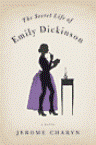
First, I recently looked at a couple of collections of book covers. Abe Books posted an exhibit of 25 Iconic Book Covers in their online Rare Book Room. Looking at those covers, I realized that about half of them were so distinctive and so familiar that I would have known the books even if the titles had been omitted from the covers. I have only to look at my own bookshelves to see some of these, such as The Catcher in the Rye and To Kill a Mockingbird. I also viewed another collection of covers. AIGA, the professional association for design, selected 100 examples of outstanding book and book cover design produced in 2009. Most of these books I’d never heard of, and only one, The Secret Life of Emily Dickinson by Jerome Charyn, had I read. Frankly, it was only one of a handful that I would have found interesting enough to stop and check the book in a bookstore or library.


The third item that has me focused on book covers is that a few weeks ago I bought a supply of stretchy fabric book covers to hide the covers of my romance novels. I bought mine locally, but they are readily available. The one pictured is from Hide-a-Book on Etsy. I have never been a fan of clinch covers, but hiding the covers always seemed like surrendering to the critics of romance fiction. I had one cover I used for my purse book, whatever it happened to be at any given time, since I pulled it out everywhere from a jury room to a church committee meeting. But lately the questions about my romance covers from the Grands have persuaded me that the time has come to cover the covers.

When I first started reading my mother’s romance novels, the covers might have been dismissed by critics as silly and trite, but they didn’t need to be hidden from the eyes of children. I thought the covers were wonderfully romantic. Clinches, when they existed were strictly G rated. What I remember are the beautiful people and the glamorous settings. I was not a fan of the bodice rippers of the 1970s, although the covers of the two most influential, which I did read, were certainly inoffensive. The books I was reading during that period were Gothic romances, Clare Darcy’s Regencies, and categories by writers such as Essie Summers, Mary Burchell, and Sara Seale. The covers of the subgenres were distinctive from one another, but none of them would have embarrassed their readers.


When I think of what some have called the Golden Age of romance fiction, the 1980s, I think of the writers I was discovering during that time, writers like Mary Balogh, Jo Beverley, Mary Jo Putney, Nora Roberts, and Kathleen Gilles Seidel. Most of their books from that time are still on my keeper shelves, and while some may be labeled “clinch covers,” none makes me want to hide it from view. Even the cover of Seidel’s All Through the Years, the sexiest of the covers in this sample, seems mild to eyes accustomed to 21st-century covers.


Was it in the 90s that the shift began? I’m not sure. This is a rambling recollection of my experience with romance covers, not an academic study. I do know that it’s easy to see the forerunners of today’s sizzling covers in Loretta Chase’s acclaimed Lord of Scoundrels and in Lisa Kleypas’s popular Then Came You. On the other hand, some books that definitely merited the “Hot” warning such as Christina Dodd’s A Well-Pleasured Lady and Judith Ivory’s Sleeping Beauty have quite subtle covers, the kind I can still leave on a table or chair, careless of who may see them. 

      
That pattern can be seen in recent covers as well. Two of the books that prompted the Grands’s questions were Julie Anne Long’s I Kissed an Earl and Anne Mallory’s Seven Secrets of Seduction. Yet Toni Blake’s Sugar Creek, which has a higher sensuality level than the Long and the Mallory books, has a cover that I feel no need to hide.


Please don’t misunderstand me. I am not advocating banning covers. Since they are so ubiquitous, I will concede that many readers must like the clinch covers and the experts insist they sell. Borders romance buyer Sue Grimshaw was quoted in a 2008 Publishers Weekly article saying, “A tastefully done clinch is a must-have for debut authors.” And in that same article, Carrie Ferron declared, “We're pro-clinch at Avon.” So I’m in a minority here not banning, just covering romance covers—some of them—and thinking nostalgically of the day when I could just leave my romances uncovered for all eyes to see and dream of a day when the covers of romance novel will be both distinctive and appealing to readers.


How do you vote on clinch covers—yea or nay? Have you ever used book covers on romance novels? What kind of covers do you prefer on the books you read?


Thursday, October 14, 2010

Reading the Seasons


Last weekend was a Grand time at our house. All seven of the grandest of grands arrived Saturday for an overnight visit. Evidently the changing of seasons had been a topic of discussion in K-6 classrooms last week because the five who are in school were all eager to talk about fall. The five-year-old brought in a leaf to show me. “It’s fall because the leaves are falling,” he said, and his almost-nine-year-old cousin’s patient explanation of the autumn equinox and light falling did nothing to change his mind. After all, he could see the falling leaves.


In keeping with our conversation about seasons, I read to them a wonderful book that celebrates all the seasons, Pieces: A Year in Poems and Quilts by Anna Grossnickle Hines. I don’t know a lot of books that work for an audience that ranges from just-turned-two to eleven going on thirty, but this book did. The little one loved the colors. We all laughed when she touched a page and lifted her hand to stare at it as if surprised to find slick paper beneath her fingers rather than the soft fabric the vibrant illustrations promised.


As I read aloud the poems and we looked at Hines’s amazing quilts—each one 12 by 18 inches, designed and hand-stitched by Hines to match seamlessly a poem about a season—I thought about the recent report that said the sales of picture books were suffering because parents were pushing even early readers into reading chapter books. All four of our readers are reading well above grade level, and they all have their favorite chapter books, Harry Potter, the Wimpy Kid, and Percy Jackson among them. But picture books were an important part of their learning to love books, and they are still frequent choices for reading aloud because of the memories and because they lend themselves so well to pausing for important discussions.


The book opens with a short poem: "Pieces of the seasons/ appear and disappear/ in a patchwork pattern/ making up a year." We spent a long time on that page, talking about what “patchwork” means and sharing images we associate with seasons and laughing at how funny it is that even here in Georgia where we don’t often have enough snow to build a snowman or snowwoman, the image says winter to us. The eleven-year-old wondered if she could learn to quilt. The ten-year-old, who has inherited the family allergy to math, was amazed at how much math Hines had used in creating her quilts. His just younger cousin, our artist, marveled at all the gradations of colors.


When we reached “Good Heavens,” my favorite poem in the collection, we ended up talking about new words and how imagination helps us see different views.

Here’s the poem and the quilt illustration:

Our lawn is astronomical
with dandelion blooms.
A green sky filled
with a thousand suns
and then
a thousand moons
that with a puff
of wind become
a hundred thousand stars.


The six-year-old loved the word “astronomical.” “It rhymes with comical,” said our red-haired, laughing imp and set the crew off on other rhyming words, most of them nonsense words such as "hippopomical" and "Bakugonical" that left everyone giggling.

On the following page, “Do You Know Green?” starts with spring green sleeping . . . waiting . . .  resting . . . but then “Green comes …. / tickling the tips / of twiggy tree fingers” and poking, springing, bursting until throughout the natural world “green grows.”  The words move on the page.
“It makes me want to dance,” the five-year-old shouted. He began to jump and twist and whirl around the room. The two-year-old joined him with a shriek of delight, and soon his other cousins and even his sister, who thinks she’s too old for such childish games, were whirling with him. The room was filled with dancing, laughing, happy children. So was my heart.
Another favorite, “To Each His Own,” carried us back to the autumn leaves that started our conversation. We all loved Hines’s images of leaves floating “lazily / wavily / and taking all / daysily."  The nine-year-old said, "She makes up words too."  And we all sighed in satisfaction to find a link between us and the writer who had given us such pleasure.

Just an ordinary Saturday became a series of special moments because we were reading the seasons.
If you have young ones to whom you read aloud, or if you are just someone who loves poetry and quilts, I highly recommend Pieces. It’s not a new book. It was published in 2001 to starred reviews from Publishers Weekly, Booklist, and Kirkus. It won the 2002 Hopkins Award for the best anthology or single volume poem written for children in the previous year. Hines published a second collection, Winter Lights: A Season in Poems and Quilts, in 2005, but it’s a subject for a holiday blog I'm planning for December.


Do you think picture books are important for children? Do you have memories of picture books from your own childhood or that you read to your children or grandchildren? What’s your favorite seasonal symbol? Can you see it in a quilt?